Thursday, January 19, 2017

Documentary about Aliya and Aleksey - summary

Russian Olympic Committee made a documentary about the love story of Aliya Mustafina and Aleksey Zaytsev. If you haven't been keeping up - they got married in November and expecting a baby.
The documentary is in Russian, so I made a summary.
Aliya starts with saying that many people think that if a girl starts a serious relationship with someone, she will not be able to continue an elite sports career. Well, Aliya disagrees and thinks she can combine sports and relationship just fine. However, there were some changes. She is extremely independent and it was new for her to be able to rely on someone, to have someone to do things for her, to take care of her. She's still not quite used to it.
They met last fall at a Moscow hospital that specializes in treating athletes - she was there for rehab after her knee surgery and Aleksey was getting a treatment for his injury (he's on the national bobsled team). They liked  each other instantly and eventually started dating, but then Aleksey went abroad for competitions, because his winter season was starting. Aleksey says that he realized things are getting serious when he went away. They spent all the free time they had from training on the phone, constantly talking and texting.
The documentary includes a short video that Aleksey sent to Aliya from Lake Placid where he says that they're always together even when they're apart and he's grateful for the existence of internet.
In December he told Aliya he'll be in Moscow on New Year on a layover to Germany and she asked him to celebrate New Year with her (in Russia this is a huge holiday). He says that in recent years it was the first New Year he spent with his loved one and not on the road.
Alexey recites a short poem he wrote to Aliya about their time apart and when he couldn't fall asleep from all the competition jitters:
Засыпаю дольше, чем сплю.
Просыпаюсь дольше, чем надо.
Как бы мне так заснуть одному,
а проснуться уже с тобой рядом?
Approximate translation (I'm really bad at translating poetry. It sounds much better in Russian): It takes me more time to fall asleep that I actually sleep and it takes me long time to wake up. I wish I could wake up next to you even though I went to sleep alone.
Aliya says one of the challenges in their relationship is that she's a very serious person and doesn't joke at all, while Aleksey jokes all the time. They're both very stubborn and it's often hard for them to compromise. Aleksey says that at first he didn't really notice that Aliya is a difficult person, even though he read it about her in the articles. Aliya comments that it's really hard sometimes for Aleksey to deal with her, but they manage.
In summer she went to Krasnodar to visit Aleksey and his parents (they live in a village near Krasnodar, it's in the southern Russia) and they've accepted her as their own daughter from the very first day, even though they couple haven't yet announced that they want to marry.
Aliya says their relationship was a big factor in her decision not to retire before 2016 Olympics, because she thought that she'd watch him competing and miss sports. Aleksey also tried to persuade her not to give up. She says that Aleksey is planning on competing for another 10 years, so she wants to return to the sport, too, after she finishes her studies (and gives birth, I guess - the documentary was shot before they made an official announcement about the baby).
For Aleksey, it was very hard to watch Aliya compete, because for the first time he was nervous for someone else. He was texting her non-stop during the Olympics even though she didn't look at her phone during the training and competition, so she would read his hundreds of texts in the evening.
Aleksey officially proposed after they both decided they want to marry. He created a quest game in their apartment, when at the end she found the ring attached to a balloon.
She went to shop for a wedding dress with her mom and a friend and chose the dress very quickly, refusing to try other dresses on. They had quite a small wedding. Aleksey says he really loved the dress and how Aliya looked on the wedding day.
They still spend a lot of time apart, because Aleksey is currently training for the Winter Olympics and competing abroad, so they can't wait to spend more time together.
They really want kids. For now, they're planning on having three kids and don't care whether if they'll have boys of girls. Although, if they have a girl. Aliys wants her to do rhythmic gymnastics.
Aliys says she's the boss in their family even though Alexey doesn't know it.
Aleksey says Aliya makes him extremely happy.

Monday, January 2, 2017

Melnikova's interview

Angelina Melnikova gave an interview to R-Sport just before New Year.
Here's the summary.
She says she used to be a very active kid, so her parents brought her to dance classes, but she didn't like dancing. Then they tried gymnastics which she liked. Later, though,  there were moments when she wanted to quit, especially that one time she had an ear infection and her ears hurt when she tumbled. She got onto the national team at the age of 11 and since then she never wanted to quit.
She really likes studying and reading, she started reading a lot at the Round Lake.
Her dad is a farmer, mom stays at home, her little brother used to do gymnastics but didn't like it, so now he's doing martial arts.
She doesn't like talking about herself.
At the moment she can't imagine her life without sport and wants to do gymnastics till 2028 (not sure whether it was a joke or she really wants to become the next Chuso). She doesn't want to become a coach but for now has no idea what she wants to do in her life besides gymnastics.
She likes all the attention she's getting after the Olympics because this way she can meet a lot of new people.
New Year is her favorite holiday. She would want to celebrate with friends, but her parents believe it's a family holiday, so she celebrates with her family.
She says she's not a very brave person, but gymnastics is not scary for her, because after many repetitions her body just knows what to do.
She loves travelling and was very impressed with Switzerland.
She likes dogs more than cats and also has a PET OWL (how cool is that?!!!!!!).
She collects plush toys (teddy bears and the like), but recently donated a big part of her collection to an orphanage.
She wishes a Happy New Year to all her fans!

Thursday, December 22, 2016

Petro Pahniuk on his career in Azerbaijan and why he returned to Ukraine

We've already learned that recently Azeri gymnastics federation, displeased with the results, got rid of the MAG national team coach and that former Ukrainian gymnast Petro Pahniuk left as well (not clear whether it was his decision).

Petro gave an interview to a Ukrainian website in which he talks about why he originally left Ukraine, how was his life in Azerbaijan and what are his plans for the future.
Here's a short summary.
He says he desperately missed Ukraine and his friends and family from the very first weeks in Azerbaijan. He originally left because of the lack of support and funding for MAG in Ukraine and hoped that with better funding he'd be able to achieve higher results. He also had issues with the new NT coach in Ukraine and didn't want to work together. Azerbaijan offered him a good salary and the training conditions there were on another level entirely, so he didn't think long before switching.
At the same time he says that in Ukraine everyone's very professional and knows how to train champions even in dismal conditions, while in Azerbaijan the higher-ups don't really know how to get results. He thinks this lack of strategic planning on the behalf of the coaches/team coordinators hampered his success and he could have had better results in Ukraine. He also feels that he was really needed  and missed on the Ukrainian national team this cycle, because it seriously lacked depth. He still loves the Ukrainian team, is very proud of them and wants to be a part of the team, even in horrible training conditions.
He is still holding an Azeri FIG license, so he'd need to be officially released by the federation. The Ukrainian federation supports his return and they'll have to ask Azerbaijan for release. Petro says that if he doesn't get a release, he'll have to wait 1 year before he can compete for Ukraine, but he's willing to do it. I know that Olympics require 3 years break, does FIG have different rules?
It seems from his tone that he expects the Azeri federation to cause trouble and, maybe, not grant a release. Looks like there's bad blood between him and the federation, although he doesn't elaborate.
He believes that his decision to go to Azerbaijan was the right one at that moment, but competing for a country other than Ukraine doesn't quite work for him anymore.
He also says that, despite the governmental support, there are powers in Azerbaijan that are not happy with the success of the MAG. I suspect he might be alluding to the conflict between MAG and rhythmic gymnastics (the former NT coach Pavel Netreba said there was a big conflict as the rhythmic coaches felt that MAG is overshadowing the rhythmic gymnasts).

Also, I just checked and Pahniuk is already removed from the AGF website as a team member. He still has an FIG licence for Azerbaijan, though, valid till May 2018.

Thursday, December 1, 2016

Israeli rhythmic gymnastics coach accused of physical abuse

I’ve just learned about the abuse scandal that happened this summer in Israel – the head coach of the rhythmic program was accused of physical and verbal abuse towards gymnasts. I have no idea how I missed this scandal, considering I’m normally on top of the news, but it somehow happened.
Anyway, in light of the recent lawsuit against the Karolys and the discussion about their coaching methods, I thought this story would be interesting to talk about.
So, first a little background on Irina Vigdorchik, the coach in question.


Vigdorchik used to be a rhythmic gymnast on the Soviet national team until she moved to Israel in 1979. Here she immediately got onto the Israeli national team, but Israel boycotted the 1980 Olympics, so she wasn’t able to go to the Olympics as a gymnast. She went multiple times as a coach and as a mom (her daughter was on the Israeli team in Beijing). She founded a gym in Holon (the host city of the 2016 Rhythmic Gymnastics Euros) and became a major figure in the Israeli rhythmic gymnastics. She did a lot for making rhythmic gymnastics a very popular (and internationally successful) sport in Israel and under her as the head coach the team won 23 international medals.

However, this summer she was at the center of an abuse scandal.

Now, below I'm trying to piece the whole story from a lot of sources in three languages (Hebrew, Russian and English). I give links to all the sources, but I don't know whether all the sources did a great job investigation the situation, so if some details are wrong, please, let me know.

It started with Kati Levin, a national team member, alleging that Vigdorchik kicked Levin during warm-up at the World Cup in Kazan in July 2016 (just a couple of weeks after the team won gold at Euros). The allegations were corroborated by another gymnast. In addition, the parents of several gymnasts sent a letter to the Israeli Gymnastics Federation, saying that it was not an isolated incident. The letter claimed that Vigdorchik repeatedly abused her gymnasts both physically and verbally and she also openly drank alcohol during practices. The gymnasts on the national team refused to be coached by her. 

Vigdorchik denied all accusations.
The Federation formed a committee to investigate the situation.

However, more drama started. 
The coach's estranged husband (they separated after 30 years of marriage) and a former official in the Federation came to her rescue, saying that she could've never hit a gymnast. According to him, the accusations are "vile lies born out of flaming jealousy" and "she can scream at gymnasts, be demanding, strict... But hit or kick them? It's impossible!" According to him, other coaches wanted to take Vigdorchik's place as the head coach and formed a conspiracy, urging parents to send a letter with fake accusations. He specifically puts blame on Ela Samofalov, another rhythmic coach, the personal coach of Neta Rivkin. Samofalov said that these accusations are ridiculous and she's going to sue for defamation (I don't know if she really did, couldn't find any information about it).
Adding to the drama was the fact that the whole thing happened less than a month before the Olympics. This year's team was the most successful in the history of rhythmic gymnastics in Israel, they've just had the historic gold at Euros and they were one of Israel's biggest hopes for a medal. Imagine changing the team's coach less than a month before Rio.

So, after investigation the committee decided that Vigdorchik would stay in charge of the team (sort of like a team coordinator), but she wouldn't be coaching them and wouldn't be allowed too close to the gymnasts.  Ela Samofalov, Raya Irgo and the choreographer Ayelet Zysman were assigned as the actual coaches. The team placed 6th in Rio. I guess they were affected by the scandal and the coaching change, who knows how much it contributed to their mistakes on the floor.

So, what's going on now?
Israeli Gymnastics Federation is looking for a new head coach, since Vigdorchik's contract was not renewed.
Vigdorchik was congratulated by many officials, including the President of Israel, on the team's performance in Rio and voted the best coach of the 2016 season by Hapoel center. She is planning on writing a column for Walla Sport, a local news site. She is planning to talk about the state of sport in Israel and how it can be improved. She thinks that the only criterion for judging a coach's performance should be the results of the athletes coached by her. She finds it outrageous that her contract wasn't renewed after the Olympics.
She also thinks that the scandal was the reason for the 6th place in Rio, because the girls couldn't train properly during the investigation (when Vigdorchik was suspended) for 10 days. On the other hand, the gymnasts are saying the scandal hasn't affected their performance at all. Vigdorchik puts a lot of blame in the scandal on the parents of the gymnasts, saying that they interfere too much with the training process. In a recent lecture she said "families are the worst", and lamented on how she gives everything to a gymnast only to learn that the family decided to move to another club. She also rants how Israeli kids aren't taught  by their families to endure hardship and to persevere through pain and disappointment, so it's hard to make good athletes out of them.
I couldn't find any information if her coaching license has been suspended or revoked by the federation and if she is allowed to continue coaching kids. I have a feeling she isn't, but she said she's open to job offers. Looks like the Federation isn't planning on employing her in any role anymore. There was no criminal investigation into the abuse allegations  and she was not sued by the gymnasts.


Monday, November 28, 2016

Oleg's interview, part 4

In the third part of the interview Oleg Verniaev talks about his plans for the next quad and for the New Year celebration.
The original interview is in Russian and you can read it here.
If you missed the first parts of my translation, go here , here and here.

Q: Are you going to try to get into all the finals at Euros and Worlds?
A: Yes, if I can. It depends on my routines. For instance, in Switzerland I had a 7.2 pbars routine, and if I do the same routine next quad, it’ll stay 7.2. However, if I don’t manage to do my Healy, my difficulty falls to 6.6. automatically, because Healy is an E element, and my score counts one more D element instead of E.* I need to either have some other elements to have room for error or train this skill until I can do it perfectly every time.

*I frankly didn’t get this part, because in new COP Healy is D. Was it E in the last quad and Oleg just doesn’t know yet that it’s been downgraded? Or does he mean some other element and there was a mistake in the article? Can anyone with MAG knowledge help?


Q: What do you like or dislike about fans’ behavior and what they say online? You now have a lot of fans, all different. How do you manage?
A: There are people who write normal stuff, but there are some who write things that I show to my friends in shock, I won’t say what things, but they’re really horrible. There are pleasant comments, but some will just blurt something that makes you speechless. I always read everything, and when there are a lot of compliments I’m slightly uncomfortable. I don’t like fans who are obsessed, who stalk all my connections and ask me questions why some friend did something, and I don’t even know what they’re talking about.

Q: How do you feel on the competition days? Are you nervous, stressed, focused, thinking only about the competition, or it’s just a regular day, when you train in the morning, rest and try not to think about the routines?
A: If it’s a serious competition, I can’t sleep. During the Olympics, I only managed to fall asleep at 4am. Otherwise, until I get to the competition hall, I don’t care whether it’s a competition day. I wake up, get a contrast shower, pack my bag, wait for the coach and I’m ready to fight.

Q: What was the hardest thing for you on the journey from London to Rio?
A: The hardest was that at every competition my coach told me that I’ve won already and set the bar high, so I have to keep it that way. And every time I need to train more and more to keep the bar high, I have more responsibility. To stay on top is the hardest.
  
Q: What are your thoughts on the fact that people started to throw dirt on all the officials who have to do with sports in Ukraine?
A: Yeah, I read what people are saying. For them, Sergey Nazarovich [Bubka] is bad, and the sports minister is bad, everyone’s bad. They’re always complaining that our minister of sport doesn’t look like an athlete and stuff. You know, how from 2008 we weren’t getting new equipment, and there were many ministers, but only the current one finally got us new equipment. He’s helping us, supporting us, we’re moving forward. Sergey Nazarovich bought us the new floor, gave us a push. Theyre helping us, so were very grateful.

Q: Is there something that needs to be changed in the Ukrainian sport?
A: Laws need to be changed, I’ve talked about this before. For example, in Germany, I was told, sponsoring gymnastics is tax deductible, so big companies invest in gymnastics and get deductions on their taxes. If we had a law like that, everything would be different. Companies need to pay taxes anyway somehow. They can choose to pay taxes directly, or they can choose to invest in sports, advertise themselves through this and do a good deed for us.

Q: What do you feel when you’re standing on the podium with a gold medal and hearing the Ukrainian anthem playing because of you? Are you less excited now because it happened many times?
A: Well, you know these memes “bang-bang-bang, Batya v zdanii”*, so when I’m standing there I feel like that, like here I am and I did my job. Really, it’s a great moment when your job is rewarded by a gold medal, all the country is supporting you and you’re giving them the gift of the national flag raised and the anthem played. At this moment, I’m not thinking anything, I’m just standing there and enjoying it. That feeling never diminishes, I’m always standing and пкшт акщь уфк ещ уфкю

*These are Russian memes based on the song “Batya v zdanii” [Daddy in da house] by MC Hovanskiy, Russia recording artist. The memes usually feature some badass person and this phrase. I’m including the link to the video if you want to watch, but basically, the meaning of the phrase in this context is  kind of like “I’m the king of the world”.

Q: Are you playing football? [for Americans, they mean soccer] You were recently seen at FC Shakhtar’s practice. Who of the players are your friends? Would you like to try out for the team? As Usain Bolt trains with Borussia and can even play if needed. What do you think about this idea?
A: I can train anywhere, but it doesn’t mean that I would play a real game. I mostly play football on Sony Playstation, and sometimes we play on floor in the gym during practice. I mostly in touch with Pyatov, Stepanenko and Rakistkiy from FC Shakhtar.


Q: I know that you’re competing a lot and you’re dreaming about vacation. What kind of vacation do you prefer? Active or passive? What do you choose: to lie in sand on a sea coast or not to stay still, keep climbing, running, walking somewhere?
A: Climbing, running and walking is really not for me, I’ve very lazy. I like to lie at the beach.

Q: We saw your 7.2 pbars in Switzerland. Does it mean that you’re going to compete this routine at Euros and Worlds next year? Or it’s not ready yet? Will you be adding difficulty on other apparatuses?
A: Of course, we’ll be trying to change and add something, because you can’t stay in one place, younger athletes are always behind, pushing and trying to pass us. Regarding the pbars, I’ve been training this routine for a long time now and I’ll be competing it. I was in Germany and my coach said that it’s ok not to finish the routine, but we added a new element, and this element has to be done all the time.

Q: You talked in one of the post-Rio interviews about wanting to start a Verniaev foundation. How’s it going, will it be possible? Or it will be killed by bureaucracy?
A: It’s turned out to be not that simple, so for now I’m not doing anything about it, I just don’t have enough experience.

Q: After the Rio Olympics you became much more popular. Do you have an official fan club or some group on a social network?
A: Of course, I’m on all the social networks myself, and there’s also a group, girls are in charge of it. Im also posting all the news myself.

Q: Do you spend a lot of time on social networks?
A: When I have time, I go online. My phone’s always with me, if there’s something important, I’, answering right away, otherwise I find time to answer later.

Q: What’s your New Year wish?
A: At this moment, I only wish that everyone will be healthy – my friends, parents, coaches. Health is the most important thing and I’ll take care of the rest. And, of course, I wish for the war in our country to stop, for all the problems to end, so that we could start growing and using our potential. Because our country can do a lot, but we’re at the bottom for now. That’s what I want. We just need to be kinder and more positive and to love other people.

Q: What are your plans for the New Year’s Eve?*
A: Depends on who’s coming to the party. Last year we had an amazing night, it was just me and two friends, we got into a car with lots of champagne and drove around the city. Of course, I wasn’t drinking, because I was driving. One of my friends is in KVN**, so he’s got a great sense of humor. I had a loudspeaker that I brought from Germany, so we were yelling jokes from the car window. If we saw a fun company, we would stop and offer champagne for a poem***, for example. Talked to everyone, offered food and drinks, had fun. We didn’t organize anything, but it was a lot of fun. That was not just a regular party at the apartment, very unusual. That was the 4th New Year I spent sober.


*For those unfamiliar with Russian/Ukrainian/Post-Soviet country, we don’t celebrate Christmas. In USSR religious holidays were prohibited, so people celebrated New Year instead of Christmas. It’s the biggest holiday of the year, everything is decorated, there are New Year’s trees, parties, and people get gifts and a long vacation. People celebrate till morning, usually with family and/or friends and they normally drink a lot. You can also find lots of people celebrating in the streets even though it’s cold. Christmas is celebrated on the 7th of January and only by religious people.

**Wow, I’m explaining a lot of cultural stuff today. This interview was for a local website and quite informal, so the audience of the website would understand all this references, but, of course, international fans are probably unfamiliar.
So, KVN is a humour competition, kind of similar to stand-up, done only in the FSU, hard to explain to foreigners. I found a Wiki article in English about it. https://en.wikipedia.org/wiki/KVN


*** In the FSU countries there’s a tradition that children get up on a chair, read a poem they memorized and get a gift for their effort. Older people do it too, especially when they’re drunk and it’s a New Year’s party. It’s fun. Some poems can be dirty. In general, we Russians know a lot of poems by heart, because we have to memorize hundreds of them at school.

Saturday, November 26, 2016

The state of gyms in the FSU countries

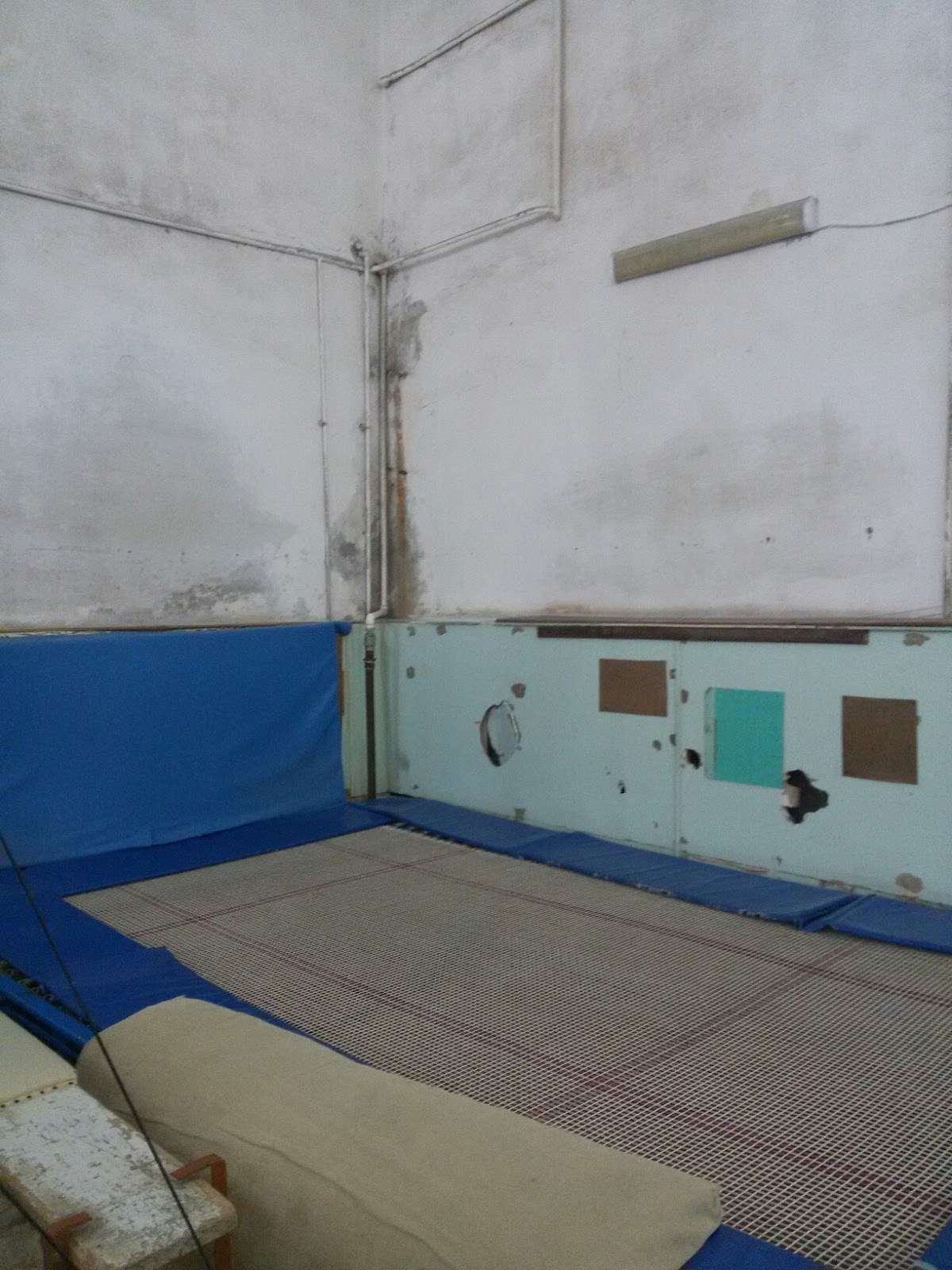
Some of you might wonder, what's with all the complaining about gyms from all the gymnasts from the former Soviet countries.
I just saw a post on vkontakte about the only gym in Astrahan (Russia). Here are the photos:


You see, gymnastics in these countries is financed by the government. I saw that some private gyms started to open in big cities, but there are sill only a few. People just either don't have the money to open a gym. Even star gymnasts don't earn a lot if they stay in Russia, it's not like the kind of money Simone Biles gets, there are just no huge advertisement contracts like this. So, gymnasts don't have money to open their own gyms and local businesses are not that interested in supporting private gyms, because they don't know whether it's going to be a profitable investment.
So, while Russia has a state-of-art gym at the Round Lake and some good gyms in Moscow and St Petersburg, local gyms in smaller towns just aren't good enough. That's why, for example, Spiridonova has to train full time at the Round Lake. Komova and Melnikova also said they don't have a good gym at home in Voronezh.
Most FSU countries don't even have one good gym. I think, only Azerbaijan has invested heavily into a gym. 

Oleg's interview, part 3

In the third part of the interview Oleg Verniaev talks about his gym life.
The original interview is in Russian and you can read it here.
If you missed the first parts of my translation, go here and here.

Q: What has changed in the national team since 2015 Worlds when you were the 12th? Can the team fight for the podium in the new quad?
A: We will certainly try. Just in a year we jumped from the 12th to 8th place, made the final in Rio. When we arrived at the Test event, top coaches thought that we might take the 5th place, maybe. We also had a bad podium training there, one guy basically broke down on all the apparatuses. We, then, called this guy our secret weapon, because at the competition he got himself together and gave his best, and the rest of the guys also did a good job, without hufe mistakes, so we got second and people started considering us again. Now we’re getting some new younger athletes, the coach is trying to motivate everyone, everyone’s busy. Just recently I was at the gym, almost finished, just sitting there. One guy went to lift barbell, two others went to train pommel horse, and the coach says “I’ll give 50 grivnas to the person who’ll do three helicopters”* So, immediately 7 people gathered around, three people did the “helicopters” and we “robbed” our coach of 150 grivnas.

*Apparently, some difficult exercise, I’m not familiar with it and googling it in Russian didn’t help, so I’m leaving it to your imagination to figure out what “helicopters” areJ))

We don’t have pits in the gym and they can’t be added to this existing gym. So, for example, I’m trying to learn triple salto on rings, and I’ve done it before, so I can do it on the mats. But the guys who’ve never done it can’t do it on the mats, because it’s such a risky dismount, they have to do it into a pit first. Maybe some of them could do the triple salto, but we just don’t have the conditions, so they’re not learning it. Things like that stall the team progress. The only solution would be building a new gym.

Q: How do you motivate yourself to work, when you really don’t want to?
A: I sit by the warm heater and wait till my coach shakes me awake again. Without a coach, it’s extremely hard to make myself do anything. I need motivation: telling off sometimes, encouragement at other times, I always need a mentor.

Q: Did you have a thought after the Olympics, that now you’re an Olympic champion, so you don’t need training, because it’s for weaker athletes?
A: I’ve had such thought even before the Olympics. And when I got the gold at the Olympics, too, I’ve had thoughts like: “Win Euros – check, win Worlds – check, win Olympics – check, win University games – check, win World Cup – check, what else would I need? Maybe I should retire?” Yeah, I’ve had these thoughts, but they leave my head pretty soon. I made certain goals for the next 4 years, and I’m going to work on achieving them.

Q: Can you tell us about your first coaches? Are you planning on coaching in the future?
A: My first coach’s name is Mikhail Vasilyevich, he used to be a circus artists. He trained me only for half a year. Then he sent me to Olga Ermakova, and she was my first serious coach, she trained me till I was 13, and I won my first Nationals with her. We were her first kids. Frankly, she didn’t quite know yet what to do with us, she was learning during the process. Five or six people from our group of 15 made “master of sport”, that was very good for the first ever group of trainees, especially for a female coach in MAG. She built our balance, made us love gymnastics, played with us. She was also pretty strict, as they say, she trained us with carrot and a stick.
When she left for Australia, her husband, Yuri Vladimirovich Ermakov, trained us. He’s a bronze Olympic medalist. We trained with him for two years, and then I finished high school and moved to Kiev, because there were more options here. Regarding coaching in the future, I don’t think I’ll be doing it. I don’t really know a lot about coaching, all the details, it’s just not for me. Of course, I can help others if needed, but coach is a really difficult job, it’s a calling.

Q: Daily training, frequent competitions, and gymnastics in general – all that takes a lot of strength, time and health. Where do you get strength, how do you recover, where do you get the energy? How much time do you need to rest and what do you do?
A: Well, for instance, when I went to Germany, the first competition day was on Saturday, I competed and took a break from gym till Tuesday night. I slept, rested, just couldn’t get out of bed, because my muscles were so sore. Usually, I compete on Saturday, rest for 5 days, and then compete again. I like competing, it’s not work for me, it’s a pleasure, so it’s easy to recover from.

Q: What are the criteria for getting on the national team? Compared to you, the rest of the team kind of pales, except for Radivilov. Do people have not enough talent and motivation, or there’s simply no depth to choose from?
A: The national team is selected by the results of the Nationals. Our goal now is the next Olympics, so we will try to get people on the team who can help us there.

Q: How many people compete at the nationals?
A: Maybe, 20 or 30 who really do something. It was different once, I remember we had like 100 people competing in Kirovograd, but we don’t anymore.

Q: Are you going to compete the triple salto on floor? A lot of people started training it, Nagorny even competed it already.

A: Yeah, I saw it, he did it really well. But it’s a hard element and I haven’t mastered it yet. I’ll try, of course, the coach said the whole team has to do it. It doesn’t mean everyone will actually compete it, even if they can do it, but it might motivate others.